

Landgoed Ducaet
Landgoed Ducaet lies in Kerkhoven, a hamlet within the town of Lommel, in the Belgian province of Limburg.
The estate's lands are recorded in the Land Registry under the name “De Ducaet” — “a piece of land situated in the "Bette Venne" marsh, known as the ducaet, west of the common watercourse, 1774, H.P. 33, 73r; coppice known as the Dukaat, 1834, Van Breugel, 22 min.”
The name itself has its roots in an act of commerce: when the estate changed hands in 1774, the purchase price was settled in gold ducats.
Those coins, in turn, trace their origin to Italy. In 1284, Doge Giovanni Dandolo — the forty-eighth Doge of Venice — ordered the striking of a new gold coin, the Zecchino, bearing the inscription:
Sit tibi Christe datus, quem tu regis iste ducatus. (“This duchy, which you govern, is dedicated to you, O Christ.”)
That final word, ducatus, would in time lend its name to the coin itself: the ducat. Weighing 3.5 grams and struck from gold of more than 23½ carats' purity, it remained in circulation for over five centuries — minted continuously from 1284 until the fall of the Venetian Republic in 1797. Such was the purity of the gold, and such the coin's longevity, that the ducat became a benchmark of international trade.
Adapted from "Van Vriesput tot Klein Duitsland – Acht eeuwen Lommelse plaatsnamen", Victor Mennen, 1992, published by the Museum Kempenland Society.
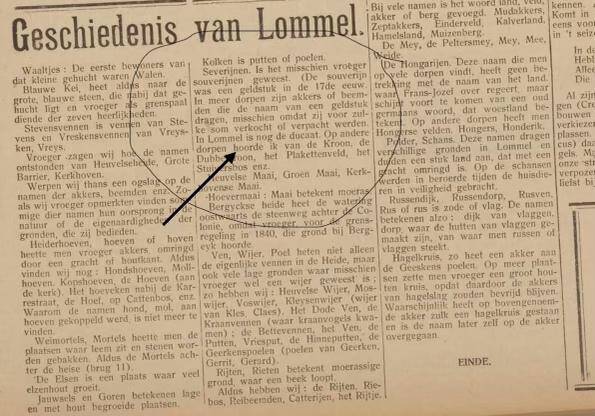
Featured quote:
“… In a number of villages there are fields or meadows named after a coin, perhaps because they once changed hands, or were leased, for such a sum. In Lommel, the ducaat survives still …”


Frontside of a Ducaet
Backside of a Ducaet


Coat of arms of Giavanni Dandolo
Doge Giovanni Dandolo, 48th Duke of Venice (1280-1289)
social media
Follow us on social media too.
You can simply stay informed of our activities via the social media channels below. We regularly post the latest news on Facebook and Instagram.